
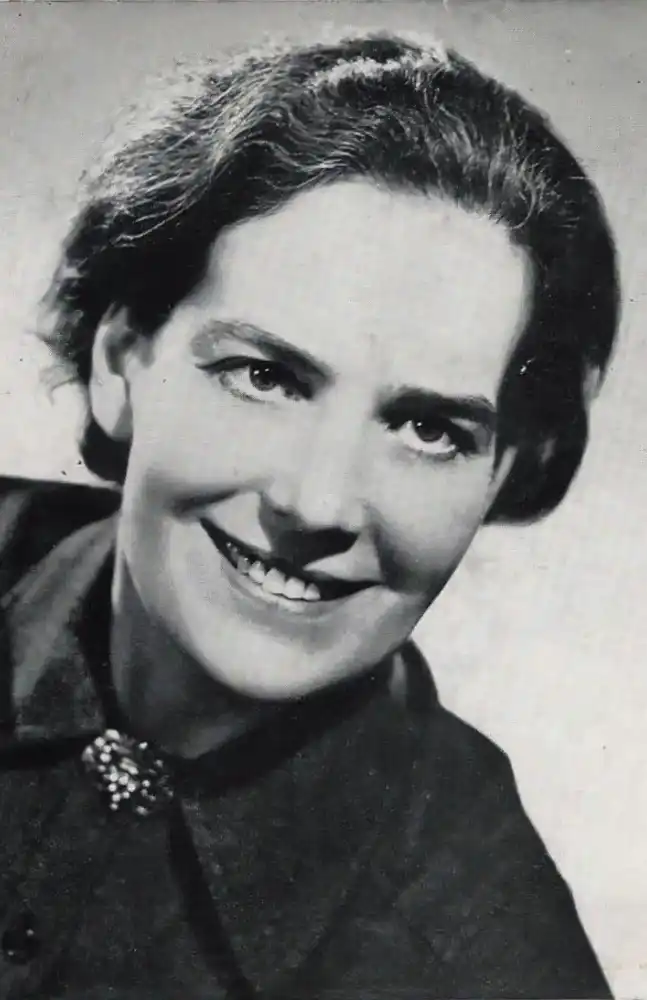
Margot Bennet
Nick Hubble
Margot Bennett (1912-1980) was the author of two distinctive and idiosyncratic science fiction novels, The Long Way Back (1954) and The Furious Masters (1968). She also wrote mainstream, mystery and crime novels (several of which have been reprinted in the British Library’s Crime Classics series with informative introductions by Martin Edwards), winning the Gold Dagger Award (then called the Crossed Red Herring Award) in 1958 for Someone from the Past. From the late 1950s she increasingly wrote film and TV scripts, including for Emergency Ward 10 and Maigret. In 1964, she was in discussions to write for Doctor Who, but these unfortunately came to nothing. Aside from writing Margot, who had four children, lived an eventful and activist life. At one time a communist, she served with the British Medical Unit in the Spanish Civil War. Later she became an anti-nuclear campaigner, joining CND and writing The Intelligent Woman’s Guide to Atomic Radiation (1964). As we shall see, scepticism concerning nuclear weapons was a constant theme of her SF work.
Born Margot Miller in Lenzie, Dunbartonshire, she emigrated with her family to Australia at the age of fifteen. While there, she swam with the Bondi Ladies Amateur Swimming Club and was one of the first women to ride a longboard in the Bondi surf. After completing school she travelled a lot, taking different jobs such as working on a New Zealand sheep farm, where she was present for the 1931 Hawke’s Bay earthquake (an experience she drew on for her 1964 novel That Summer’s Earthquake). Later she worked as a copywriter, first in Sydney and then, by 1935, in London where she was working for the advertising firm, Lintas. However, only a year later, she was to join the select band of British volunteers in the International Brigade who would participate in the Spanish Civil War in defence of the Republican government against Franco’s Nationalists.
She left Victoria station in London with the first contingent of the British Medical Unit (BMU) on 23 August 1936. Margot was described in contemporary news reports and early historical accounts as an ‘Australian nurse’, despite being neither of these. As her great niece, Veronica Maughan, explained in 2022, writing for the magazine of the International Brigade Memorial Trust, she had always retained her British passport but could easily have been mistaken for an Australian in terms of outlook and personality: ‘She was unorthodox, anti-authoritarian, independent and outspoken’. Although she had knowledge of first aid and therefore was able to provide some medical assistance if required, her primary role with the BMU was probably as a journalist and publicity writer. The Spanish Medical Aid Committee (SMAC), which funded the BMU, had a relatively sophisticated press strategy in order to maximise support for the cause. As a member of the Communist Party of Great Britain (CPGB) and professional writer, Miller was an ideal candidate to help with this propaganda effort.
The BMU set up a field hospital in Grañén, near Huesca, about 18km behind the Aragon front, where George Orwell would fight in 1937 as described in his Homage to Catalonia (1938). While based at the hospital Margot met her future husband, Richard Bennett, who was broadcasting in English as the ‘Voice of Spain’ for the radio service of the PSUC (United Socialist and Communist Party of Catalonia) in Barcelona and visited the BMU to report and publicise it. Richard had first crossed the border into Spain on 6 August 1936 with the poet John Cornford, whom he knew from their time at Cambridge and also through Communist circles. By 13 August, Cornford had enlisted with the militia of the POUM (Workers’ Party of Marxist Unification) – as Orwell would some months later – and was fighting on the Aragon front (from where he wrote a famous poem to a different Margot, Margot Heinemann). When Cornford fell ill and was taken to a nearby Spanish hospital, Richard came out to visit him on 10 September. A week later, Cornford was back in England gathering a group of volunteers to return to Spain and join the Communist International Brigades. He was subsequently killed in action during the defence of Madrid on 28 December 1936, the day after his twenty-first birthday.
In the meantime, Margot had also been injured, hospitalised and returned to Britain. While running across open country to give aid to a wounded soldier, she was shot by a machine-gunner in both legs and then had to lay under fire for some time before she could be rescued. She was hospitalized for several weeks in Barcelona and presumably Richard was able to visit her during this period. On Friday 27 November 1936, she was discharged and flown to London for an Aid for Spain fundraising event taking place on the Sunday night at the Albert Hall. Here, she limped on to the stage and was presented to the audience before being seated on the platform in a position of honour next to Harry Pollitt, the General Secretary of the CPGB. As her great niece notes, Margot’s heroic tale was covered by newspapers across the world.
Margot returned to Spain the following year, joining Richard in Barcelona and working with him at the radio station. The Spanish marriage certificate from their wedding in April 1937 lists her profession as ‘journalist’. This was an interesting time and place in which to get married because it coincided with the rapid breakdown of the relationship between the various political parties and forces defending the Republican government in the Civil War. At the beginning of May, open street fighting broke out between the Communist-dominated PSUC on one side, and the Trotskyite POUM and the anarchists on the other, as memorably recounted in Homage to Catalonia by Orwell, who was a participant. In a footnote to Hugh Thomas’s monumental history, The Spanish Civil War (1961), we are told how at this time Richard’s door in Barcelona was opened by ‘two men carrying bombs who bluntly asked him; “Whose side are you on?” “Yours,” he wisely answered.’
At some point after these dangerous events, Margot and Richard seem to have relocated to a news service in Madrid. However, the initial unity of the cause was now fractured. According to the historian Jim Fyrth, Margot and Richard eventually left Spain because they began to feel unsafe following an argument over broadcasting policy with a German worker from the Comintern (the Communist International). As testified to by personal accounts of the period, such as Orwell’s, paranoia and suspicion had taken hold of the Republican side, leading to political repression, disappearances and killings. It may be that, following their return to Britain, Margot and Richard left the CPGB. They don’t seem to have still been members later on. However, it’s not clear exactly what they were doing at this time. Later, during the Second World War, Richard worked for the Army Bureau of Current Affairs (ABCA).
From 1943 Margot’s short stories and articles started appearing in Lilliput, a sister magazine of Picture Post. She remained a regular contributor up until 1950. During the last four years of this period, Richard was the editor of the magazine, and several other ex-communists were involved, including the artist James Boswell who was to provide the cover illustration for the UK edition of The Long Way Back. At least one of Bennett’s Lilliput stories was SF. ‘An Old-Fashioned Poker for My Uncle’s Head’ appeared in the August 1946 issue and was later republished in the May 1954 edition of The Magazine of Science Fiction & Fantasy. It’s a comic story, as fits Lilliput’s general tone, although there is also a dark edge to the humour, reflecting the altered reality of the post-Hiroshima age.
The narrator tells the story of her 1920s childhood when her mother’s brother, Uncle Albert, who was living with the family, became an inventor. At first he invents gadgets and devices that already exist, such as the oil lamp, the steam engine and the telephone. Thus, the story provides an amusing recapitulation of scientific progress. However, as her uncle moves on to the electric light and the radio, the narrator reports her father’s disdain turning into fear: ‘“He’s catching up, Susan,” he muttered to my mother. “Now we really have got to stop him.”’ As her father’s hair begins to fall out and he becomes increasingly consumed with anxiety, the narrator’s uncle turns to the question of ‘defence’ and invents new types of mines and a pilot-less bombing plane. Finally, Uncle Alfred announces at breakfast that everything he has previously invented is obsolete because he’s now ‘got a bomb that splits the atom’. The narrator is sent out to buy a back collar stud by her visibly agitated father. She returns from this strange errand to find the house on fire and her father standing outside next to her mother, who has fainted. When she goes to ring the fire brigade, her father remarks complacently that he is afraid that they won’t be able to save Uncle Albert. The story closes with the narrator wondering whether her father had done the right thing: ‘I mean it did give us another fifteen years after all.’
The implicit anti-nuclear-weapons attitude of this story would become a strong feature of Bennett’s two SF novels and is also apparent in the opening of an article she wrote for the March 1948 issue of Lilliput, ‘Space-Ships also Leak’:
Most of us were blown a little out of spirits by the atom bomb, but the incredible-science writers had scarcely time to be astonished before they became inspired. The old rockets-to-Mars were scuttled and new atomic space-ships set off at once for fresh planets to discover something more lethal than plutonium. Radio-active mothers produced some interesting human mutations, and as mutant met and courted mutant a new and not altogether sympathetic race sprang up. There are twenty different magazines that tell the same tale. Don’t be afraid of taking that last sentence too literally. Astounding Science Fiction does not differ notably from New Worlds; and Strange Adventures, Futuristic Stories, and Amazing Stories are robot triplets, queer, uncanny, and supernatural to an identical degree.
The space-story has a frame almost as rigid as the sonnet. There is an interplanetary armaments race, a space-ship in search of the ultimate war-winning metal, and a hero who saves the Galaxy after a stiff fight against man-eating mud, cosmic envelopes, or scheming icicles.
There are still some ‘space-stories’ written to the same formula today. Margot was certainly correct concerning the interchangeability of Strange Adventures and Futuristic Stories: the entire contents of both magazines were written by Norman Firth under various pseudonyms. Overall, this article, which carries on in similarly witty and perceptive vein, is a fascinating piece of early SF criticism and demonstrates Margot’s interest in the genre at this time. Her account is not utterly disdainful throughout. It’s noticeable that she prefers the stories that were published in Astounding, singling out Chan Davis’s ‘Letter to Ellen’ and a couple of others I haven’t been able to identify for relative praise. Nevertheless, the overall impression Margot would have left Lilliput’s readers with is that such pulp content was best avoided. Her own SF was to be much more in keeping with the British tradition from H.G. Wells to Aldous Huxley.
First Novel
Margot’s first novel, Time to Change Hats had been published in 1945. This was a comedy mystery, which she followed up with a sequel, Away Went the Little Fish (1946). There then followed a sequence of thrillers and crime novels: The Golden Pebble (1948), The Widow of Bath (1952), Farewell Crown and King (1952), The Man Who Didn’t Fly (1955), and Someone from the Past (1958). Among these appeared The Long Way Back, which was very different in terms of its future setting. It’s set several centuries on from now and tells the story of an anthropological trip from Africa ‘to investigate primitive Britain’, which we come to realise must have bombed itself back into the stone age during the twentieth century.
The set-up for the novel is reminiscent of Huxley’s Brave New World (1932). We are introduced to a utopian mechanised society in Africa through the eyes of Grame, a discontented anti-hero; a type which would be immediately familiar to a 1950s readership. Grame was classified as a ‘mechanical-repetitive worker’ at the age of seven by ‘the grading machine’, but after teaching himself to read and write has been studying physics for years and now wants to work on cosmic rays. To this end he applies for regrading and is brought once more before the machine, which struggles to grasp the source of Grame’s dissatisfaction:
‘Have you any complaints about conditions in your hut? Have you an adequate tobacco-room?’
‘I don’t want to discuss tobacco-rooms. I want to appeal against my grading.’
‘Have you any complaints about sex facilities in your hut? Have you an adequate sex cubicle?
‘Damn sex facilities. I want to be regraded as a physicist. I appeal to you,’ Grame said wildly. ‘I appeal to you as a machine. I appeal for regrading.’
The exchange eventually ends with the machine breaking down due to its inability to accept that anyone could be unhappy with the system. As a result, Grame is dragged before the sub-controller, who – in time-old middle-management style – decides to make the problem disappear by offering Grame a place on the anthropological expedition to Britain: ‘“What an enthralling business anthropology is!” he said musingly. “I’ve always claimed it’s a pity we couldn’t have kept the Boors in their natural state. I’m afraid they’ve degenerated a little in their reserve.”’ Later, as Grame is forced to acquire the necessary qualification of an Anthropology degree in 24 hours, he is given a brief historical summary of how ‘the ancient world’ came to an end when ‘Britain finally attacked the Romans, the Russians and the Americans’. The lecturer concludes this account by admitting that ‘even here we have no written history of events of that period although legend says white slaves were once imported to this part of Kenya to work on our own primitive farms.’ The tone of the novel is therefore set as one of dry humour and dramatic irony, with an undercurrent of political subversion.
The Britons, when we finally encounter them, turn out to be whiter than the Boers, short, thin-lipped and have narrow noses. They don’t like change and they don’t like strangers. The women allow themselves to be treated as inferior and ‘sent their sons to be initiated by a week alone in the murderous forest, and accepted the principle that the old men must make the laws because they had always made the laws.’ The first act of the African party is to play the Britons a recording of an atomic explosion which is accompanied by a narration: ‘This colossal development heralds a new era of peace and prosperity for United Africa. Listen now, to the sound of the old world’s passing. Are you ready for the great division of the atom?’ As is obvious to readers, and will eventually become clear to Grame and his companions, the ultimate product of this development is likely to be another reversion to primitive society.
Not all the targets of the humour and subversion are so immediately obvious seventy years later as they might have been at the time. For example, the expedition is led by Valya, a member of the ‘dedicated spinster class’, who is also described as a ‘bride of the state’. While, in places Valya’s actions are clearly intended to satirize by-the-book leadership, her refusal for much of the novel to adopt the traditional love-interest role for Grame enacts a form of feminist resistance. The consequence is that at times, The Long Way Back reads similarly to the work of so-called ‘angry young men’ such as Kingsley Amis, whose Lucky Jim was also first published in 1954. However, Grame is never quite allowed to become an unproblematic hero and attain all he feels entitled to. Aware, that in the landscape of Britain, he can see the signs of civilization rising and falling in cycles, he decides to free himself from such struggles and, in the words of Valya, becomes ‘more like a savage everyday’:
There was nothing left of the shy aggressive youth she had met the first day in Africa. He was a savage now, proud of his ability to hurt and kill; indifferent to hardship; effortlessly brave. In the forest, he was magnificent. She could not imagine how his new qualities would serve in Africa.
This is quite a complex message and it is possible to see why The Long Way Back attracted some attention at the time of its publication. However, how it came to date fairly quickly is also apparent. The reversal in status between Africa and Britain does enable some telling satire on the conservative nature of 1950s Britain, which was still embroiled in colonialist wars at the time, not least in Kenya – the apparent setting of the opening scenes of the novel. However, this reversal is mainly instrumentalized to support the anti-nuclear message and therefore doesn’t really constitute the critique of colonialism that a modern readership would expect. The action scenes aren’t convincing, serving mainly to link together the sections of social commentary. Finally, although interesting, the relationship between Grame and Valya isn’t enough to carry the novel on its own. This is primarily because Valya is never afforded enough agency for her to become a protagonist of the novel in her own right. Having said all that, the novel remains historically interesting precisely because it highlights all these areas of contestation which would become taken up by the explicitly liberationist writing of a generation later. In this respect, Margot can be seen as very much ahead of her time.
In the 1960s, Margot wrote fewer novels, concentrating instead on the more lucrative earning potential of TV. Her second SF novel, The Furious Masters, was to be the last of her published works. This is a lighter, faster-paced novel than The Long Way Back but no less satirical in intent. A group of students discover what appears to be an alien spacecraft on a remote spot of the Yorkshire Moors, setting off a media frenzy and, it gradually becomes apparent, a spate of violent and sometimes sexually aggressive behaviour from those who have been in the vicinity of the landing. This theme and the way it’s sometimes presented suggests that Margot was still maintaining an interest in SF magazines, possibly including New Worlds, then at the peak of its fame. While some of her specific targets include the behaviour of the press – Richard worked for the Sunday Telegraph during the 1950s and 1960s – and the civil service, the subtext of The Furious Masters is that sexual repression is linked to living under the threat of nuclear weapons. The depiction of the state’s panic-stricken response to the breakdown of this repression may therefore be seen as a satire on the British establishment’s awkward and uncomprehending reaction to the sexual revolution.
We witness most of this dynamic from the perspective of two of the students, Cressida – the main protagonist – and, to a lesser extent, her friend Sue. They are prominently featured in the press coverage and forced to spend much of the novel fending off the (mostly) unwanted attentions of various men. Inevitably, they are blamed for this and charged with conspiracy: ‘No one has done more to release these dreadful passions than the young Miss Cressida Jenkins.’ Cressida and Sue’s response to much of this might seem flippant and jarring to a contemporary readership. For instance, they often joke with each other about rape, but we should probably see this as a means of coping with a realistic threat. The novel doesn’t pull its punches. In one scene, the female Secretary of State for Education is stripped and ritually murdered at the altar of a church. However, there is a wonderful moment right at the end of the novel when Cressida, on the run, is lying naked on the moor at night, beside her lover, and he tells her: ‘All the space-ships on the moon are shining on you. They’ve turned you into a witch.’ Despite some dated aspects, therefore, The Furious Masters points the way forward from the black-and-white postwar decades of Britain to the twenty-first-century feminist perspectives that are more prominent in science fiction and fantasy today.
Overall, Margot Bennett lived an interesting life both as a political activist and a professional writer. The evidence here suggests that she engaged with science fiction across several decades and therefore deserves to be known to the field and have at least the same level of recognition within it that she has for her crime writing.


Margot Bennett, The Long Way Back, London: The Bodley Head, 1954
Margot Bennett, The Furious Masters, London: Eyre & Spottiswoode, 1968
Both out of print, sadly.